The most important skill to learn in 2026 might not be as technical as you might have thought; it's likely the underestimated skill that we've been ex...
The most important skill to learn in 2026 might not be as technical as you might have thought; it's likely the underestimated skill that we've been exposed to since we were kids, which is the ability to read, write, and pay attention to details. It has been noted by researchers that the adoption of Generative AI is significantly altering human cognition, influencing how we engage with information, think, reason, and learn. Its impact has been adverse to these cognitive variables.Natural Language Processing has emerged as an important tool in the IT field, especially in software development and programming.You might have read various articles and research papers on the psychological impact of modern technology adoption; the results are not fabricated or exaggerated. The technology we use daily indeed has an impact on the way we think, behave, reason, memorize, and recall information. Impact of short-form media and the autocorrect featureShort-form media social platforms such as TikTok, Facebook, and YouTube have been noted to have a direct contribution to the reduced attention span of platform users. We spend time scrolling from one video to another without spending more than 30 seconds to get the context of the video; we just cold scroll, hoping to find something that might interest us. GPS-based navigation has had an impact on spatial cognition. We no longer pay attention to a lot of things unless we are "Hooked" into it. The majority of social media content creators have observed the behavioural change, and they are exploiting it to get our attention. We mostly now pay attention only to things that we are interested in, not necessarily the important things; we just need an element of interest before we can be able to decide that it is important. Something can be important but not interesting, and stand a chance of being ignored.Artificial Intelligence algorithms use Natural Language Processing as a backbone of their functionality in simple terms, which is just English, since most of people are now relying more on artificial intelligence to generate text for them we can easily deduce the psychological impact that this systems have on the ability to write for individuals, we have been using tools like autocorrect and instead of relying on them as a corrective measure of our mistakes that we need to learn from most of us having been using the autocorrect features blindly so, even though the primary intended use case was for corrective measures. Comparing cognitive processes engaged in the given scenario when a novice uses the web versus an LLM for support, with fainter arrows indicating weaker engagement | Obtained from https://arxiv.org/pdf/2502.12447v1The above diagram illustrates that people using generative AI have more creative output, but less ability to remember and understand, etc. We have seen most of this effect where people are trying to write software programs without understanding the foundational syntax, making it difficult for them to have a predicted effect of the code they wrote or remember how they managed to achieve a particular outcome.Due to the wide adoption of Artificial Intelligence systems, such as agentic automation, there's an increasing demand for people who will write prompts, supervise the system, and help it make decisions. That requires people who can remember how a task is done, understand it, apply it, critically analyze the results generated by the AI system, and evaluate them. The introduction of Agent Skills has made work automated through an AI Agent to be more procedural. Natural Language ProcessingComputers used to understand programming language syntax when building software, but now we use Natural Language Processing to instruct computers. Times have changed, and productivity has vested in cognitive skills rather than technical skills.Your ability to pay attention is an important skill in the age of AI; this skill is needed for supervision purposes for critical human-in-the-loop tasks. The introduction of Artificial Intelligence is giving rise to a demand for cognitive skill sets that are depleting over time due to the wide adoption of technology. An AI Prompt Engineer must possess cognitive skills to be effective and efficient in their task. The labour market of self-taught individuals is increasingly rendering academia a less preferred route for professional training. This is due to its inability to quickly respond to the fast-changing environment of the skillset demand in order to ensure that people are trained for the skills that are in demand. People now rely on more self-training to update their skills and stay relevant.ConclusionAs much as organic food for the food industry has increased in value due to the introduction of genetically modified food, we predict an increase in demand and value of organically generated outputs (content generated without the use of Artificial Intelligence). The ability to write, remember, understand, apply, analyze, and evaluate will be the most sought-after skills for individuals in the work space.ReferencesProtecting Human Cognition in the Age of AI
The most important skill to learn in 2026 might not be as technical as you might have thought; it's likely the underestimated skill that we've been exposed to since we were kids, which is the ability to read, write, and pay attention to details. It has been noted by researchers that the adoption of Generative AI is significantly altering human cognition, influencing how we engage with information, think, reason, and learn. Its impact has been adverse to these cognitive variables.
Natural Language Processing has emerged as an important tool in the IT field, especially in software development and programming.
You might have read various articles and research papers on the psychological impact of modern technology adoption; the results are not fabricated or exaggerated. The technology we use daily indeed has an impact on the way we think, behave, reason, memorize, and recall information.
Impact of short-form media and the autocorrect feature
Short-form media social platforms such as TikTok, Facebook, and YouTube have been noted to have a direct contribution to the reduced attention span of platform users. We spend time scrolling from one video to another without spending more than 30 seconds to get the context of the video; we just cold scroll, hoping to find something that might interest us. GPS-based navigation has had an impact on spatial cognition.
We no longer pay attention to a lot of things unless we are "Hooked"into it. The majority of social media content creators have observed the behavioural change, and they are exploiting it to get our attention. We mostly now pay attention only to things that we are interested in, not necessarily the important things; we just need an element of interest before we can be able to decide that it is important. Something can be important but not interesting, and stand a chance of being ignored.
Artificial Intelligence algorithms use Natural Language Processing as a backbone of their functionality in simple terms, which is just English, since most of people are now relying more on artificial intelligence to generate text for them we can easily deduce the psychological impact that this systems have on the ability to write for individuals, we have been using tools like autocorrect and instead of relying on them as a corrective measure of our mistakes that we need to learn from most of us having been using the autocorrect features blindly so, even though the primary intended use case was for corrective measures.
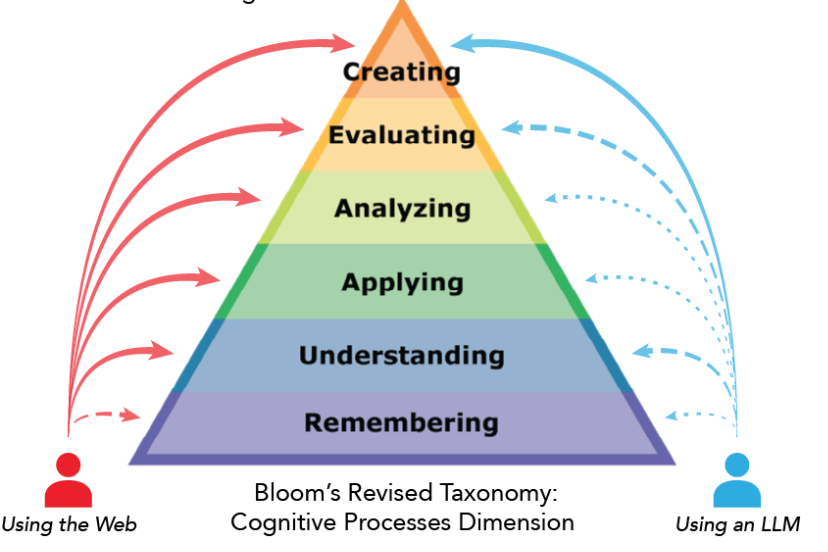
Comparing cognitive processes engaged in the given scenario when a novice uses the web versus an LLM for support, with fainter arrows indicating weaker engagement | Obtained from https://arxiv.org/pdf/2502.12447v1
The above diagram illustrates that people using generative AI have more creative output, but less ability to remember and understand, etc. We have seen most of this effect where people are trying to write software programs without understanding the foundational syntax, making it difficult for them to have a predicted effect of the code they wrote or remember how they managed to achieve a particular outcome.
Due to the wide adoption of Artificial Intelligence systems, such as agentic automation, there's an increasing demand for people who will write prompts, supervise the system, and help it make decisions. That requires people who can remember how a task is done, understand it, apply it, critically analyze the results generated by the AI system, and evaluate them. The introduction of Agent Skills has made work automated through an AI Agent to be more procedural.
Natural Language Processing
Computers used to understand programming language syntax when building software, but now we use Natural Language Processing to instruct computers. Times have changed, and productivity has vested in cognitive skills rather than technical skills.
Your ability to pay attention is an important skill in the age of AI; this skill is needed for supervision purposes for critical human-in-the-loop tasks. The introduction of Artificial Intelligence is giving rise to a demand for cognitive skill sets that are depleting over time due to the wide adoption of technology. An AI Prompt Engineer must possess cognitive skills to be effective and efficient in their task.
The labour market of self-taught individuals is increasingly rendering academia a less preferred route for professional training. This is due to its inability to quickly respond to the fast-changing environment of the skillset demand in order to ensure that people are trained for the skills that are in demand. People now rely on more self-training to update their skills and stay relevant.
Conclusion
As much as organic food for the food industry has increased in value due to the introduction of genetically modified food, we predict an increase in demand and value of organically generated outputs (content generated without the use of Artificial Intelligence). The ability to write, remember, understand, apply, analyze, and evaluate will be the most sought-after skills for individuals in the work space.
We use cookies to enhance your browsing experience, serve personalised ads or content, and analyse our traffic.
By clicking "Accept All" you consent to our use of cookies.
Cookie Policy
⚙️
Cookie Preferences
Essential Cookies
Required for the website to function. Cannot be disabled.
Always On
Analytics Cookies
Help us understand how visitors interact with our website anonymously.
Marketing Cookies
Used to deliver personalised ads and measure their effectiveness.
Functional Cookies
Enable enhanced functionality and personalisation features.
Comments 0
Log in or register to comment.
No comments yet — be the first.